A couple of decades ago, when the T-Rex expansion was still tearing up I-25, a Cory-Merrill neighborhood association board member named Kent Olson used to drive the neighborhood with a notepad, logging every teardown he passed. He counted ten scrape-offs in a single year on blocks that had gone largely untouched since the postwar era. His explanation, at the time, was simple: Wash Park, Bonnie Brae, University Park and Belcaro had gotten too expensive or too built out, and Cory-Merrill hadn't. "We're a real bargain to developers now," he told Denver Westword.
That bargain never really ended. It just moved indoors, into the spreadsheets that now try to describe what a Cory-Merrill home costs, and it produces numbers that contradict each other from one website to the next.
Why the Lots, Not the Location, Explain the Teardowns
Ask why Cory-Merrill became Denver's scrape-and-rebuild neighborhood instead of Bonnie Brae or Wash Park, and the answer isn't proximity or school quality alone. It's the dirt itself. Cory-Merrill was platted with lots running 6,000 square feet and up, while the postwar subdivisions in neighboring Bonnie Brae and Wash Park typically run 3,000 to 4,500 square feet. That difference of a few thousand square feet is the difference between a lot that can absorb a wide-body custom home with a three-car garage and a main-floor primary suite, and one that physically can't.
The original housing stock on those big Cory-Merrill lots came from a specific builder era. Many of the neighborhood's brick ranches were built by developer Les Tremblay, using solid masonry construction priced for GI Bill financing. They were solid, modest, and never designed to be the ceiling of what the lot could hold. Once land values rose enough to make demolition financially worthwhile, the lot size did the rest of the work. A builder scraping a 3,500-square-foot lot in Bonnie Brae is fighting setbacks and side-yard limits the whole way. A builder scraping a 6,500-square-foot lot in Cory-Merrill has room to build something genuinely large without pushing the edges of what the zoning allows.
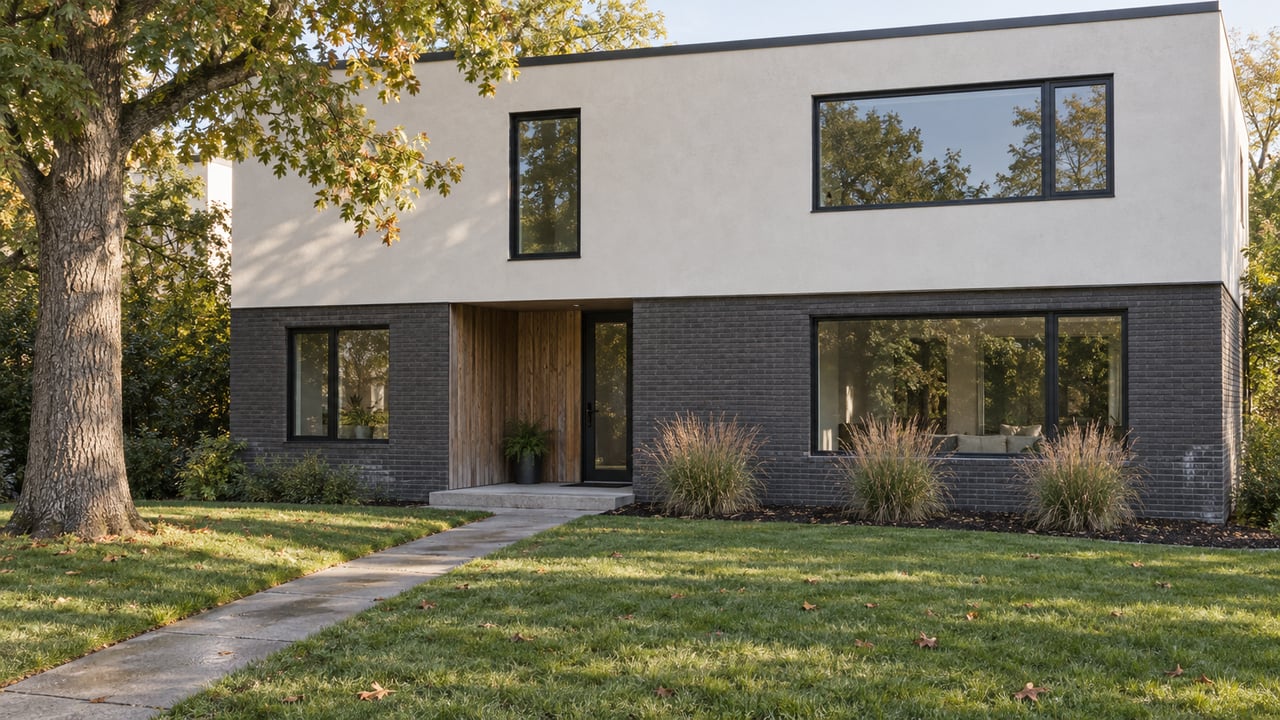
That's the part the online listings rarely explain outright, but it's the reason a buyer touring Cory-Merrill this fall will see a 1950s brick ranch, a 2024 architectural build with structural steel and floor-to-ceiling glass, and a half-scraped lot with a demolition permit taped to the door, all within a two-block walk.
What That Does to the Number You See Online
Pull up Cory-Merrill's market stats on three different sites in the same week and you'll get three different stories. Orchard's trailing 30-day window put the median sale price at $1,225,000, down 41.4 percent year over year, on just 14 recorded sales. Homes.com's listings page reported a trailing 12-month average sale price of $1,536,131, up 19 percent. A separate Homes.com neighborhood guide page, pulled the same month, put the trailing 12-month median at $1,125,000, down 21 percent.
| Source (pulled September 2026) | Metric | Window | Figure |
|---|---|---|---|
| Orchard | Median sale price | Trailing 30 days | $1,225,000, down 41.4% YoY, 14 sales |
| Homes.com listings page | Average sale price | Trailing 12 months | $1,536,131, up 19% |
| Homes.com neighborhood guide | Median sale price | Trailing 12 months | $1,125,000, down 21% |
None of these numbers are wrong. They're measuring the same handful of transactions from different angles, in a market small enough that the angle matters more than usual. Orchard counted just 14 closings in its trailing 30-day window. A market that size doesn't smooth out. If two $2.8 million custom builds close in the same 30-day window as a $650,000 original ranch, the median swings hard in one direction. If the reverse happens the next month, it swings back. Add the fact that one figure above is an average and another is a median, and the gap widens further, because averages get pulled upward by the neighborhood's ceiling in a way medians don't.
This is the direct consequence of the same lot-size mechanism that built the teardowns. A neighborhood with a narrow, consistent range of home values reports a stable median because most of what sells looks similar. A neighborhood spanning $580,000 original bungalows to $3 million-plus estates on the same streets will report whatever the top or bottom of that range happened to trade that month. Anyone comparing Cory-Merrill's advertised median against a more architecturally uniform neighborhood is not comparing two markets on equal footing. They're comparing a wide, lumpy distribution against a narrow one.
The School Boundary That Puts a Floor Under the Old Stock
The one thing holding a price floor under Cory-Merrill's older, unscraped homes is Cory Elementary School's Highly Gifted and Talented program, run on an Integrated Cluster Model that keeps gifted students in the same classrooms as their peers rather than pulling them into a separate track. Families who want that specific program pay to live inside the attendance boundary, whether the house on the lot is a 1952 brick ranch or a 2023 rebuild. That demand doesn't discriminate by architecture. It attaches to the boundary line itself.
Practically, this means an original ranch inside the Cory Elementary boundary can command a premium over a similar house a few blocks away outside it, independent of the home's condition or finishes. Anyone evaluating an older Cory-Merrill listing purely on square footage and finish quality is missing the part of the price that has nothing to do with the house.
What a Scrape or Pop-Top Actually Requires Now
For a buyer eyeing one of Cory-Merrill's remaining large-lot ranches with rebuild potential, the process runs through Denver's context-based zoning system, which is more granular than a single blanket approval. The city separates review into distinct tracks: Residential Review, Structural Review, Energy Review, Zoning Review, and Zone Lot Verification Review. A full teardown starts with its own demolition permit before construction review even begins. A pop-top, where the second story is added but the footprint stays, can fold partial demolition into the construction permit itself.
The Cory-Merrill Neighborhood Association is a registered neighborhood organization with the city, which means its members receive formal notice of proposed zoning amendments, landmark designation applications, planning board hearings and board of adjustment hearings in the area. In practice, that means a rebuild project doesn't move through quietly. Neighbors often see it coming well before the framing goes up.
Comparing Cory-Merrill Against Wash Park or Bonnie Brae
For a buyer cross-shopping these neighborhoods, the practical difference isn't prestige. It's what the lot size lets a builder do, and what that does to the range of home types you'll find. Wash Park and Bonnie Brae's narrower postwar lots cap how large a replacement home can get, which keeps their housing stock more uniform and their appreciation curve steadier and easier to read from the outside. Cory-Merrill's wider lots created room for the full range, from unrenovated original stock to architect-driven estates, which is exactly why its reported median swings by tens of percentage points depending on which month and which site you check.
Neither pattern is better. They're two different products built on two different foundations, literally.
A Few Direct Questions
Is all of Cory-Merrill zoned the same way? The neighborhood's zoning is context-based, meaning what a lot can hold depends on the surrounding block pattern as much as a blanket height or setback rule, so two lots that look similar on paper can have different real limits.
How many homes actually trade in Cory-Merrill in a given month? One recent 30-day snapshot counted 14 closings, which is why any single month's median should be read with caution.
Does the Cory Elementary boundary line up neatly with the neighborhood's edges? Attendance boundaries and neighborhood boundaries aren't always identical, so a specific address should be checked against the current district boundary rather than assumed from the neighborhood name alone.
If you're comparing what a Cory-Merrill lot actually allows against what you'd get a few blocks over in Bonnie Brae or Wash Park, that's a conversation worth having before you make an offer, not after. Rachel Gallegos works this stretch of central Denver street by street, lot by lot, and can walk you through what a specific address can and can't become. Get Access To Our Private Listings.